 ENG
ENG KOR
KORWorkshops / Short Courses
Workshops & Short Courses
Workshops and Short Courses play a vital role at international conferences in disseminating knowledge.
At IMWA 2026, they will be one of the main highlights of the event.
These sessions will offer participants a unique opportunity to gain deeper insights into specific topics or broaden both academic and practical expertise. Detailed information can be accessed by clicking the “i” icons below or by navigating below.
At IMWA 2026, they will be one of the main highlights of the event.
These sessions will offer participants a unique opportunity to gain deeper insights into specific topics or broaden both academic and practical expertise. Detailed information can be accessed by clicking the “i” icons below or by navigating below.
- Date: Sunday, 5 July 2026
| Presenters | Title | Registration fee | |
|---|---|---|---|
| General | Student | ||
| (i) Rui Hugman, Jeremy White, Pablo Ortega, Brioch Hemmings |
Reliable Mine Water Management with Open-Source Software – From Coupled Flow & Reactive Transport to Uncertainty Analysis | 170,000 KRW (≈100 €) | 170,000 KRW (≈100 €) |
| (i) Aldo Anselmo, Layane Silva, Julien Declercq | Water Quality Modelling: From Conceptual to Numerical Models | 420,000 KRW (≈250 €) | 210,000 KRW (≈125 €) |
| (i) Christian Wolkersdorfer | Hydrogeological Tracer Techniques for Ground, Surface and Mine Water | 420,000 KRW (≈250 €) | 210,000 KRW (≈125 €) |
Flow & Reactive Transport
Reliable Mine Water Management with Open-Source Software – From Coupled Flow & Reactive Transport to Uncertainty Analysis
- Presenters: Rui Hugman (Ph.D., Groundwater Modeller, INTERA Geoscience), Jeremy White (Ph.D., Hydrogeologist, INTERA Inc.), Pablo Ortega (Ph.D., Geochemical Modeller, INTERA Geoscience), and Brioch Hemmings (Ph.D., Groundwater Modeller, INTERA Geoscience)
- Registration fee: 170,000 KRW (≈100 €) (General and students)
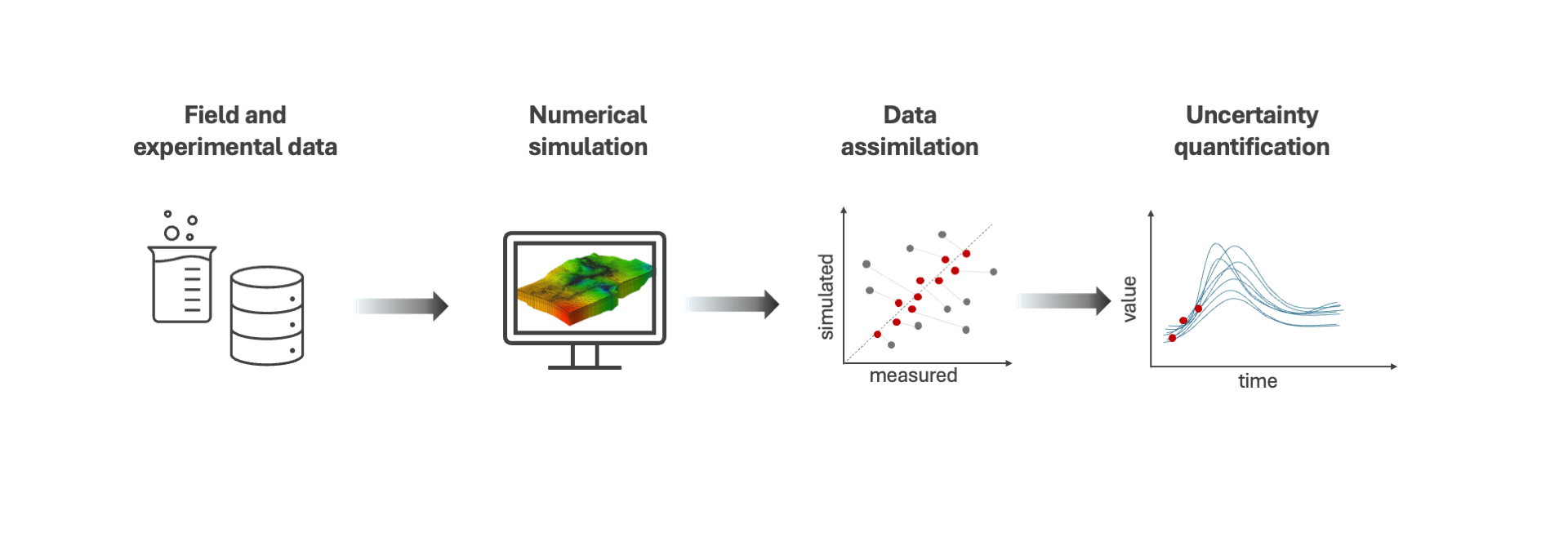
Effective mine groundwater management often relies on models that integrate hydrogeological and geochemical processes to support defensible decisions. Numerical models, though inherently uncertain, are essential for predicting dewatering performance, fate and tranport of contaminants, and long-term water quality issues related to mine operations. This workshop introduces a decision-focused approach to modeling that prioritizes predictive performance, uncertainty quantification, and data assimilation as a means to provide robust decision support to resource managers, operators and stakeholders.
Participants will learn how free open-source software can be applied to groundwater flow and (coupled) reactive transport simulations to improve the reliability of forecasts and quantify uncertainty of mine-related impacts. The workshop will demonstrate how these methods enable risk-informed decision-making and how they can be used to guide data collection strategies for uncertainty reduction.
The workshop is aimed at mine hydrogeologists, geochemists, geotechnical engineers, numerical modellers, and managers who develop or rely on models for operational or regulatory decisions during all phases of mining. The material will be accessible to those with general modelling experience and will also extend the capabilities of advanced practitioners interested in uncertainty analysis and decision support.
The workshop is structured in three parts:
Part 1: Introduction to open-source software for coupled flow and transport modelling.
Part 2: Introduction to the theory and concepts of uncertainty analysis, data assimilation, and decision support modelling.
Part 3: Real-world examples of application for mine water management, including pit dewatering, contaminant transport, and legacy site remediation.
Participants will engage in interactive discussions exploring how to align modelling with decision needs, evaluate risk, and communicate model forecast reliability effectively.
By the end of the workshop, participants will:
Participants will learn how free open-source software can be applied to groundwater flow and (coupled) reactive transport simulations to improve the reliability of forecasts and quantify uncertainty of mine-related impacts. The workshop will demonstrate how these methods enable risk-informed decision-making and how they can be used to guide data collection strategies for uncertainty reduction.
The workshop is aimed at mine hydrogeologists, geochemists, geotechnical engineers, numerical modellers, and managers who develop or rely on models for operational or regulatory decisions during all phases of mining. The material will be accessible to those with general modelling experience and will also extend the capabilities of advanced practitioners interested in uncertainty analysis and decision support.
The workshop is structured in three parts:
Part 1: Introduction to open-source software for coupled flow and transport modelling.
Part 2: Introduction to the theory and concepts of uncertainty analysis, data assimilation, and decision support modelling.
Part 3: Real-world examples of application for mine water management, including pit dewatering, contaminant transport, and legacy site remediation.
Participants will engage in interactive discussions exploring how to align modelling with decision needs, evaluate risk, and communicate model forecast reliability effectively.
By the end of the workshop, participants will:
- Understand the principles of decision-focused modelling.
- Understand approaches to data assimilation, uncertainty analysis and optimization.
- Be familiar with open-source tools that support predictive modelling and coupled flow and reactive transport modelling.
- Be familiar with resources for self-guided training.
Water Quality Modeling
Water Quality Modelling: From Conceptual to Numerical Models
- Presenters: Aldo Anselmo (Associate Geochemist, WSP Australia), Layane Silva (Associate Geochemist, WSP Australia)
- Registration fee: 420,000 KRW (≈250 €) (General), 210,000 KRW (≈125 €) (Student)
Water quality modelling has become an essential component of mine water management and environmental assessment worldwide. Increasingly, regulatory approvals and project designs require quantitative predictions of water quality of different scenarios, including pit lakes, waste rock dumps, and tailings storage facilities. However, many professionals and students in the mine water sector lack of formal training in developing and applying these models effectively. This workshop responds to the growing need for basic and hands-on training to connect conceptual understanding with numerical implementation. It aims to help all students, researchers and professionals to produce defensible numerical models understanding the limitations to support decision-making in mining and environmental projects.
This short course is designed for professionals who are involved in mine water quality-related projects including hydrogeologists, environmental engineers, geochemists, among others. It targets participants with limited or intermediate experience in numerical modelling.
By focusing on practical applications and accessible tools, the course aims to build confidence and competence among attendees who wish to integrate water quality modelling into their work or research. Therefore, the programme combines theory modules, discussion, step by step examples, and hands-on exercises, allowing attendees to participate actively. The course is divided in the following three main topics:
By the end of the course, it is expected that participants will have a clear understanding of best practices for developing water quality models, including their limitations and the appropriate interpretation of results. They will also gain practical skills that will allow them to develop high-level models with PHREEQC codes. A comprehensive slide pack summarising the key topics and examples will be provided for future reference.
If the outcome is achieved, this will have a positive impact on the water sector since better informed practitioners will be able to produce more reliable models that make the most of available data and resources, ultimately supporting more effective water management and decision making. This course aims to strengthen the technical foundation of students, researchers and professionals who will be responsible for safeguarding water resources.
This short course is designed for professionals who are involved in mine water quality-related projects including hydrogeologists, environmental engineers, geochemists, among others. It targets participants with limited or intermediate experience in numerical modelling.
By focusing on practical applications and accessible tools, the course aims to build confidence and competence among attendees who wish to integrate water quality modelling into their work or research. Therefore, the programme combines theory modules, discussion, step by step examples, and hands-on exercises, allowing attendees to participate actively. The course is divided in the following three main topics:
- Developing a hydrogeochemical conceptual model: Defining our systems and understanding the processes that control water chemistry.
- Data collection and preparation: How to develop a sampling and analysis plan, laboratory tests and organising data to develop source terms for model input.
- From conceptual to numerical models: How to translate conceptual models into quantitative simulations. This section includes practical exercises using the software PHREEQC, including examples of pit lakes, waste rock drainage and tailings water quality prediction.
By the end of the course, it is expected that participants will have a clear understanding of best practices for developing water quality models, including their limitations and the appropriate interpretation of results. They will also gain practical skills that will allow them to develop high-level models with PHREEQC codes. A comprehensive slide pack summarising the key topics and examples will be provided for future reference.
If the outcome is achieved, this will have a positive impact on the water sector since better informed practitioners will be able to produce more reliable models that make the most of available data and resources, ultimately supporting more effective water management and decision making. This course aims to strengthen the technical foundation of students, researchers and professionals who will be responsible for safeguarding water resources.
- Requirement: Attendees need a laptop
Hydrogeological Tracer
Hydrogeological Tracer Techniques for Ground, Surface and Mine Water
- Presenters: Christian Wolkersdorfer (South African Research Chair for Acid Mine Drainage Treatment, Tshwane University of Technology)
- Registration fee: 420,000 KRW (≈250 €) (General), 210,000 KRW (≈125 €) (Student)
The need for the workshop
Tracer tests are one of the few methods that enable the direct investigation of flow paths, residence times, mixing processes and hydraulic connectivity in mining-influenced water (MIW) systems. In practice, however, they are underused and often applied incorrectly. Common shortcomings include the selection of an unsuitable tracer, insufficient planning, an inadequate sampling design, missing mass balances and an unrealistic interpretation of results.
Mine water systems differ fundamentally from natural aquifers and rivers. They are engineered, poorly documented, density-stratified, chemically reactive and subject to operational and legal constraints. Applying standard tracer concepts without adaptation often produces misleading results. This workshop addresses this issue by providing a coherent framework that incorporates practical experience, proven methodologies and documented failure cases, all of which are tailored to mine water conditions.
Target audience
The workshop is aimed at mine water practitioners and consultants; regulators and authorities involved in permitting and mine closure; researchers and postgraduate students in hydrogeology and mining-related disciplines; and operators of mine water treatment and discharge systems. Participants are expected to have basic hydrogeological knowledge, but prior tracer experience is not required.
Workshop programme and facilitators
The one-day workshop combines focused lectures with case studies and discussion.
The workshop is led by Prof. Dr. habil. Christian Wolkersdorfer and includes additional case input from experienced colleagues from the International Mine Water Association (IMWA) network, subject to availability.
Expected outcomes and effect on the water sector
Participants will learn to design, commission and critically evaluate tracer tests under mining conditions. For the water sector, this will lead to a more consistent and defensible use of tracer methods, improved technical decision-making in remediation and mine closure, and reduced reliance on costly trial-and-error approaches in mine water management.
Tracer tests are one of the few methods that enable the direct investigation of flow paths, residence times, mixing processes and hydraulic connectivity in mining-influenced water (MIW) systems. In practice, however, they are underused and often applied incorrectly. Common shortcomings include the selection of an unsuitable tracer, insufficient planning, an inadequate sampling design, missing mass balances and an unrealistic interpretation of results.
Mine water systems differ fundamentally from natural aquifers and rivers. They are engineered, poorly documented, density-stratified, chemically reactive and subject to operational and legal constraints. Applying standard tracer concepts without adaptation often produces misleading results. This workshop addresses this issue by providing a coherent framework that incorporates practical experience, proven methodologies and documented failure cases, all of which are tailored to mine water conditions.
Target audience
The workshop is aimed at mine water practitioners and consultants; regulators and authorities involved in permitting and mine closure; researchers and postgraduate students in hydrogeology and mining-related disciplines; and operators of mine water treatment and discharge systems. Participants are expected to have basic hydrogeological knowledge, but prior tracer experience is not required.
Workshop programme and facilitators
The one-day workshop combines focused lectures with case studies and discussion.
- Tracer principles for mine water (MIW) systems: conservative and reactive tracers, salts, dyes, isotopes and particles
- Test design and planning: objectives, scale, tracer mass calculation, density and temperature effects, safety and legal aspects.
- Tracer tests in flooded underground mines: stratification, shafts, short-circuiting and lessons learned.
- Applications in treatment and discharge systems: residence times and bypass detection.
- Sampling and evaluation: breakthrough curves, mass recovery and uncertainty.
The workshop is led by Prof. Dr. habil. Christian Wolkersdorfer and includes additional case input from experienced colleagues from the International Mine Water Association (IMWA) network, subject to availability.
Expected outcomes and effect on the water sector
Participants will learn to design, commission and critically evaluate tracer tests under mining conditions. For the water sector, this will lead to a more consistent and defensible use of tracer methods, improved technical decision-making in remediation and mine closure, and reduced reliance on costly trial-and-error approaches in mine water management.